With twelve team members, a functioning SaaS product, and an expanding customer base, your startup is off to a good start. Security matters, but no one carries “compliance manager” in their job title. One day, a prospective enterprise customer asks for a SOC 2 report.
What should you do next?
Downloading dozens of policies immediately is not the first step for founders researching how to get SOC 2 certification. The better move is to make a few decisions that define what your company needs to document, put in place, and prove.
Decide What Your First SOC 2 Audit Should Cover
The AICPA Trust Services Criteria serve as the standard that SOC 2 evaluates controls against. Security, Availability, Confidentiality, Processing Integrity, and Privacy are the areas they cover. Among them, only Security is mandatory. The remaining categories are added when they’re relevant to the organization’s services and commitments. For a startup offering a straightforward business application, beginning with Security alone may work, provided that scope meets customer expectations.
Before you collect any evidence, identify the applications, infrastructure, employees, and service providers involved. Keeping the scope overly broad creates extra work, but it doesn’t necessarily improve the report’s usefulness.
Choose the Report That Matches Your Deadline
Anybody wondering how to get SOC 2 certified soon runs into two reporting options. The design of controls at a specified date is what Type 1 covers. Type 2 goes further, evaluating design and operating effectiveness throughout a defined period. Where an enterprise customer needs evidence fast, Type 1 can be a practical starting point, if the customer accepts it.
For businesses investigating how to get SOC 2 type 2 certification, the process includes an observation period, commonly three to twelve months, followed by an independent examination. Type 1 isn’t a mandatory prerequisite for Type 2. Find out what your customer requires before committing to either examination.
Close the Day-to-Day Security Gaps First
Connecting security controls to everyday business activities makes SOC 2 preparation easier to manage. Consider requiring multi-factor authentication for important accounts, establishing a documented employee offboarding process, and reviewing access permissions regularly.
Evidence of production changes and approvals should be retained by development teams. Record risk assessments and relevant supplier reviews at the management level. Draft policies so they describe what employees actually do. If nobody follows it, even a beautifully written procedure has limited value.
Gather Evidence as You Go
SOC 2 for saas companies comes down to demonstrating that relevant controls exist and, for Type 2, operate consistently. You might be asked for records showing when a former employee’s access was removed or whether a production deployment received appropriate approval.
Collecting these records as activities occur is far easier than reconstructing them months afterward. Small teams can manage this work with CertAssist’s built-in controls, editable policy templates, evidence checklists, and document storage.
There’s no need for direct integrations with company systems. Auditors can be given read-only access, while teams upload evidence themselves.
Why SOC 2 Requires an Independent Auditor
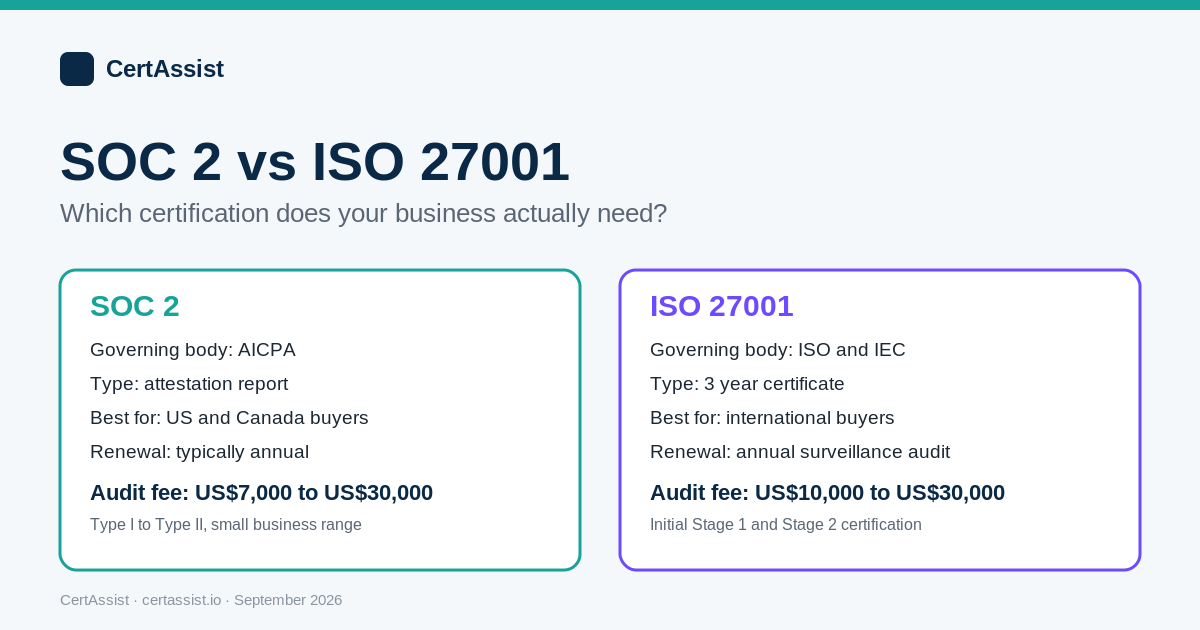
What SOC 2 produces is technically an attestation, not a certification. The examination is conducted by a licensed CPA firm, which then issues the SOC 2 report. Compliance software helps prepare and organize evidence, but it cannot replace the independent auditor.
On the software side, CertAssist advertises a US$225 monthly promotional subscription that covers SOC 2, ISO 27001, and its other supported frameworks. Independent audit fees are billed separately. A quote from an auditor reflecting your business size, selected criteria, and intended reporting period should come first.
Keep the Process Manageable After the First Report
A completed SOC 2 examination shouldn’t mark the end of your security work. Things keep changing: employees join and leave, applications change, and new suppliers appear. It matters that your controls stay relevant.
Make sure responsibilities are clearly assigned, evidence is retained throughout the year, and documented procedures are reviewed regularly against reality. That discipline helps make future examinations easier for a growing startup, while also supporting the security expectations of customers who depend on your software.